Rough opal does not arrive at a cutter's bench looking like jewellery. It arrives as a dusty lump of clay and ironstone that might be worth the trip and might be potch. The route between those two states runs through shafts, mullock heaps, buckets of water, dealers' parcels and a string of quick judgements made in poor light. Follow one stone along that route and the marks on a finished opal begin to make sense.
Down the shaft and along the level
Opal forms where silica-rich water moves through gaps in rock and leaves behind a lattice of tiny spheres. Those spheres diffract light, which is why colour shifts as you tilt a stone. The geology decides almost everything about the mining: sedimentary opal sits in bands within claystone and sandstone, while boulder opal forms inside ironstone in Queensland.
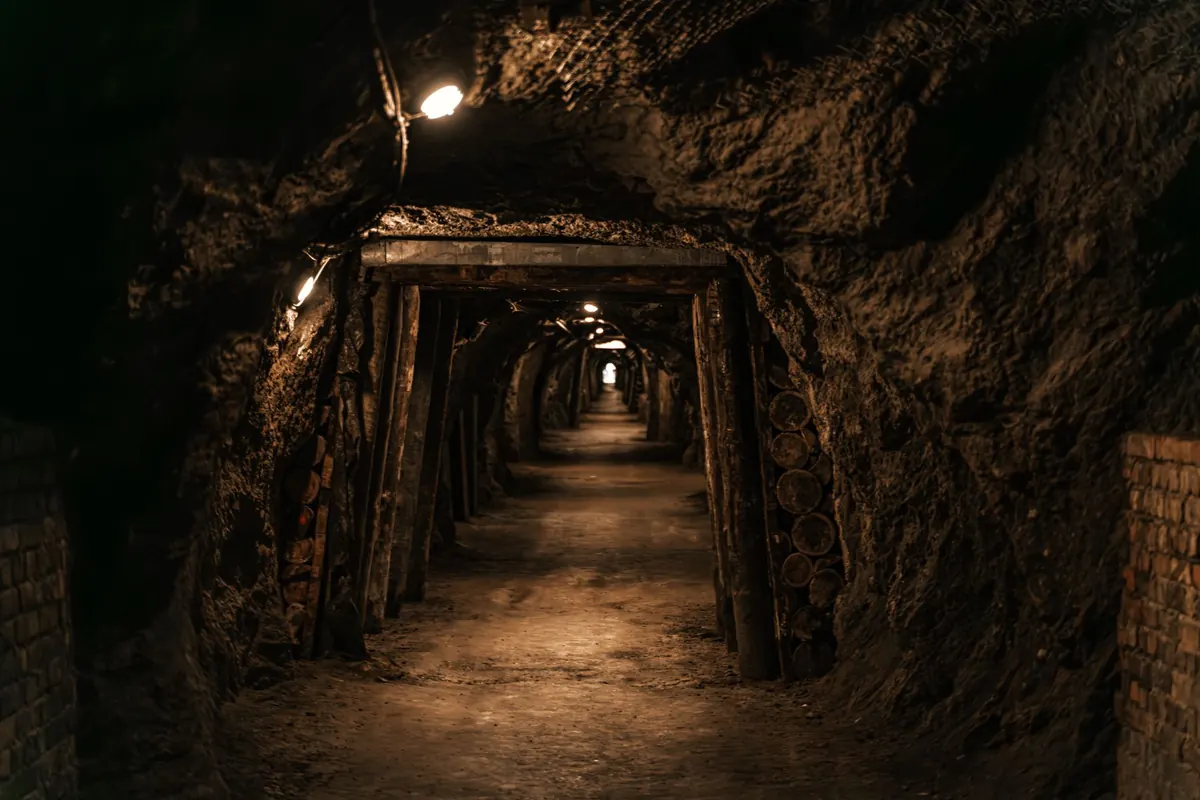
On the New South Wales fields, a miner typically sinks a narrow shaft to reach the level where opal is known to occur. Some shafts are only a few metres deep; others run much further down, and depth varies between fields and even between neighbouring claims. Historically the dirt came up in a bucket on a hand windlass. Now a small hoist, an auger or a truck-mounted rig does much of that work, but the principle is unchanged: get down to the level, then work sideways.
Those sideways tunnels — drives — follow the opal-bearing band. A miner cuts with a jackhammer, a pneumatic pick or hand tools, and leaves pillars of untouched ground to hold up the roof. Ventilation matters, and so does dust; most drives are cramped, noisy and warm. At the face, the miner reads the wall constantly: flecks of colour, a thin seam of potch, a nodule sitting in the clay, a change in the sandstone. Any of those can signal a pocket of good material a metre further on.
Lifting, mullock and the first cull
When a bucket of dirt reaches the surface, the first sort happens within seconds. Nothing is washed first. The miner wipes the clay off with a thumb and a splash of water from a bottle, and looks for colour. Stones showing a face go into a tin, a pocket or a jar of water. The rest goes onto the mullock heap.
That heap is not always waste. Noodlers — people who work the old heaps by hand, with the landholder's permission — still find small pieces, and on some fields the heaps are picked over for years.
Handling at this stage is deliberately slow. Opal is brittle, and rough straight out of the ground may already carry fractures you cannot see. Dropping a promising nodule onto a steel bucket rim can end its life as a gem before it has been properly looked at.
Washing: clay off, colour on
Washing is where the stone starts to reveal itself. A bucket of water and a soft brush removes the worst clay, and some miners use a cement mixer or a small trommel with a mesh screen and plenty of water. The aim is gentle agitation, not scrubbing. Opal sits roughly 5.5 to 6.5 on the Mohs scale, softer than quartz, so one grain of sand trapped under a brush can leave a scratch across a colour face.
Two views matter. Wet, a stone shows its colour and pattern clearly, which is why dealers keep a spray bottle on the bench. Dry, the same stone looks pale and flat — but cracks, crazing and sand lines show up far better. Experienced handlers look at both, and many keep rough in water or in sealed bags, because freshly mined opal holds moisture and drying it too quickly in hot, dry air can craze it. If you store rough at home, that habit is worth copying. Ethiopian hydrophane opal is the exception: it takes up water and can go temporarily clear, so keep that material dry.
Sorting and grading at the field
Grading at the mine is a rough-and-ready business. A parcel gets split by eye into piles that will be sold together, and the categories are consistent even when the judgements are quick:
- Colour and brightness. A stone with a strong, even face is separated from one with a faint flash.
- Pattern. Harlequin, flash, rolling, floral, ribbon and pinfire all sort differently, and pattern can lift a modest stone.
- Body tone. Black, dark and light, judged on the face rather than the back.
- Type. Black, crystal, white, boulder and matrix opal follow different markets and different cutting plans.
- Size and shape. A nobby with a rounded colour bar cuts differently from a flat seam.
- Defects. Sand, cracks, potch patches and internal flaws push a stone down a grade or into the specimen pile.
The number that matters most is yield. A boulder opal's value depends on how much ironstone has to stay attached to hold the colour together; a thin seam on potch may yield only one small cabochon. Field grading is therefore provisional. Cutters routinely re-grade, because only the saw reveals what is inside.
From mine gate to cutting bench
Most rough leaves the field through a mine-gate buyer or a rough dealer. Small pieces are commonly bundled into parcels sold as runs or tumbled rough, where the price reflects the risk that a good share turns out to be potch. Better stones are sold singly, sometimes at auction or through a dealer's parcel list. Buyers assess them the same way the miner did: wet, dry, under a loupe, sometimes with a torch behind the stone to check for cracks. It pays to keep a note of where a parcel came from and when it was bought — provenance helps later if you ever resell or insure the cut stones.
At the cutter's bench
Cutting is slow, wet work, and the sequence barely changes from workshop to workshop:
- Assess the rough wet and dry, with a loupe, and mark the intended orientation. The colour bar usually wants to sit at the top of the dome so the face plays across the whole stone.
- Dop the stone — fix it to a wooden or metal dopstick with wax or glue, best face up, so it can be held safely.
- Trim with a water-cooled diamond saw, taking off ironstone and potch in small cuts. Let the blade do the work and keep the stone cool.
- Grind the shape on a coarse wheel, usually 80 to 220 grit, forming a high, even dome and rubbing out flat spots.
- Sand through finer grits, keeping the stone wet and turning it regularly so the scratches run in different directions.
- Polish with cerium oxide or tin oxide on felt or leather. Low speed, plenty of water, no heat.
- Inspect in daylight and indoors, checking for scratches, sand lines and any sign of crazing, then record the weight and photograph the finished stone.
Heat is the enemy throughout. Opal holds water, and a stone left spinning too long on a polishing wheel can crack. Thin pieces and boulder opal need a lighter touch again. Some cutters carve, and a few facet crystal opal, but the cabochon remains the default because a dome concentrates the colour better than flat facets.
What the journey tells a buyer
Once you know where a stone has been, you know what to inspect. An evenly domed opal with a high crown, no flat patches and no visible sand line has been cut by someone who understood the rough. Look closely at the edges, where cracks and crazing tend to appear, and tilt the stone under a lamp and in daylight — colour that only works under one light is worth knowing about before you buy.
Ask what has been done to the stone. Treatments such as sugar-and-acid blackening or smoking, resin filling, and doublets or triplets are all sold in the trade, and disclosure is normal practice; if a seller cannot tell you, treat the answer as part of the price. Store opals away from prolonged heat and strong sun, skip the ultrasonic cleaner, and keep doublets and triplets out of water.
If you plan to chase rough yourself, note that mining claims are licensed and access to land is restricted; check the rules with the relevant state or territory mining authority, and get the landholder's permission before you pick up a shovel. For anything valuable — a purchase, a valuation or an insurance policy — take advice from a qualified gemmologist or valuer rather than relying on a bench opinion.
Photo: Pho Tomass / Pexels